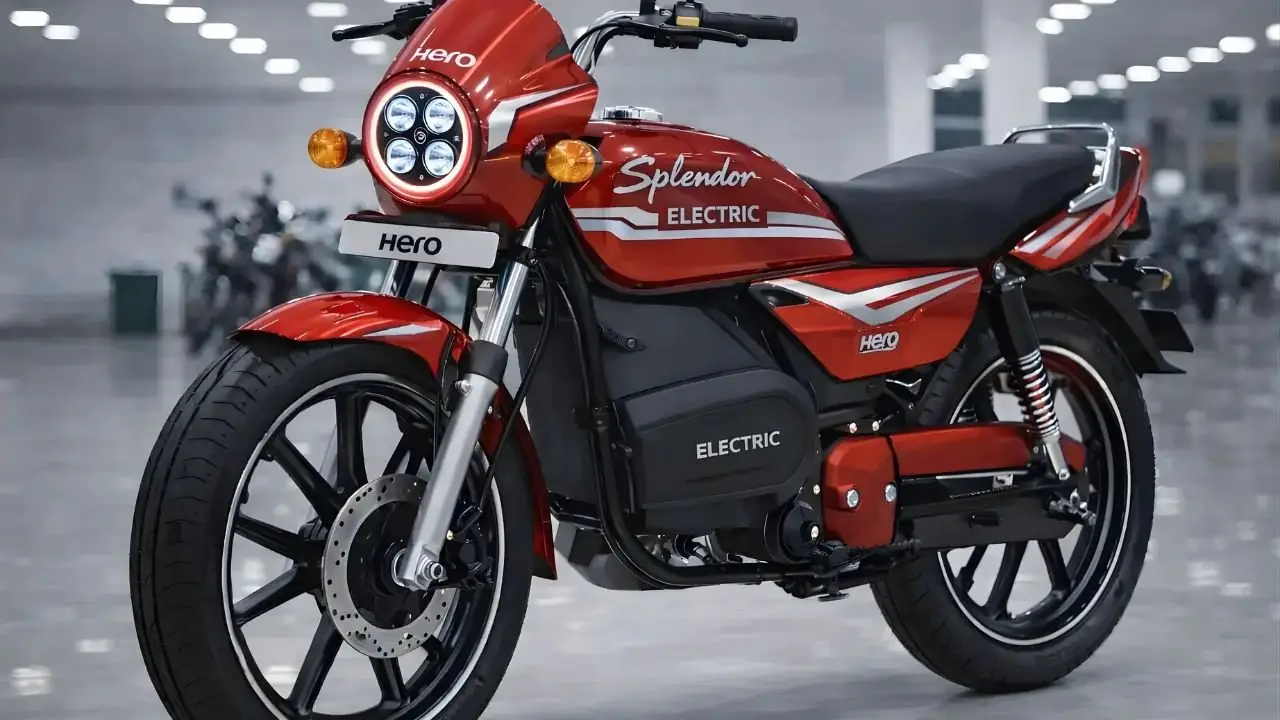
When Hero MotoCorp decides to electrify the Splendor, the entire Indian two-wheeler industry pays attention. The Splendor is not just a motorcycle — it is the single best-selling two-wheeler in the history of Indian motoring, a machine so deeply embedded in the daily lives of millions of commuters that its name has become practically synonymous with affordable, reliable personal transport. So when Hero officially launched the Splendor Electric 2026 today, with a 160 km claimed range, a 3kWh battery, and EMI plans starting at ₹20,550, the announcement carried weight that extends well beyond a single product launch.
This is the moment the mainstream Indian commuter’s relationship with electric mobility could genuinely begin to shift. Previous EV launches in India have succeeded in capturing early adopters, urban professionals, and environmentally motivated buyers. The Splendor Electric 2026 targets an entirely different and vastly larger demographic — the daily commuter in tier-2 cities, semi-urban areas, and rural markets who has trusted the Splendor name for decades and has been waiting, consciously or not, for a reason to consider going electric that feels financially and practically safe enough to act on.
Design: Familiar by Design, Not by Accident
The Splendor Identity, Carefully Evolved
Hero has made a deliberate and strategically sound decision with the Splendor Electric’s visual presentation. The motorcycle retains the upright posture, the practical proportions, and the overall form language that existing Splendor owners recognize immediately. This is not creative timidity — it is a precise understanding of who buys this motorcycle and what triggers their confidence at the point of purchase.
The changes that signal the electric identity are applied with restraint. EV-specific badging, updated graphics, and modernized lighting elements give the Splendor Electric a distinct visual character without creating the kind of radical departure that would make a conservative buyer feel they are taking a risk on something unfamiliar. The message the design communicates is clear and carefully calibrated: this is still the Splendor you trust, now powered differently.
For a product whose success depends on adoption by buyers who are making their first transition from petrol to electric, that design continuity is not a compromise — it is a core feature.
Battery and Range: The Numbers That Matter Most
3kWh and 160km — Understanding the Real Story
The 3kWh lithium-ion battery powering the Splendor Electric 2026 delivers a claimed range of 160 km on a single charge. As with all claimed range figures, real-world performance will vary based on rider weight, road surface, riding speed, and the proportion of stop-start versus free-flow riding in a typical journey.
A realistic expectation for the Splendor Electric’s target rider — someone covering 30–60 km daily on a mix of urban and semi-urban roads — would be a real-world range of 110–130 km under typical conditions. That figure is sufficient to handle two to three days of average commuting between charges for many users, which fundamentally changes the psychological relationship with range anxiety that has deterred potential EV buyers.
The battery’s engineering prioritizes reliability and longevity over peak range performance — an appropriate emphasis for a motorcycle designed for multi-year, high-cycle daily commuter use rather than occasional leisure riding. For a buyer who covers 15,000–20,000 km annually on a Splendor, battery durability over the ownership period matters more than squeezing an additional 20 km from each charge cycle.
Charging Practicality for Real Households
Home charging compatibility means the Splendor Electric 2026 plugs into a standard domestic power outlet overnight, arriving at full charge each morning without any alteration to daily routine. For buyers in smaller cities and rural areas where public charging infrastructure remains sparse, this home-charging capability is not a convenience — it is the product’s most important practical attribute.
Performance: Electric Power, Splendor Values
The electric motor in the Splendor Electric 2026 delivers the characteristic that matters most in Indian urban commuting: instant, accessible torque from zero rpm. Pulling away from traffic signals, threading through congested intersections, managing the unpredictable pace changes of mixed urban traffic — the electric motor’s immediate response handles all of these with an ease that a petrol engine at equivalent displacement cannot match.
Operation is quiet and vibration-free, which represents a genuine quality-of-life improvement over the mechanical character of the petrol Splendor. For a rider spending an hour or more daily in the saddle, the absence of engine noise and vibration reduces the subtle fatigue that accumulates across years of commuting in ways that are difficult to quantify but easy to feel.
The performance envelope has been tuned for commuting competence rather than sporting ambition — appropriate, honest, and correctly matched to what this motorcycle’s buyer actually needs from it daily.
Smart Technology: Connected Commuting for Every Budget
The fully digital instrument cluster on the Splendor Electric 2026 displays speed, battery charge level, remaining range estimate, and riding mode selection in a clear, readable format. Hero has ensured sunlight readability — a non-trivial engineering consideration in a country where outdoor daytime riding represents the overwhelming majority of use cases.
Smartphone connectivity allows riders to monitor battery health, track ride statistics, and receive vehicle alerts remotely via a dedicated application. This connected capability, available at the Splendor’s price point, reflects how dramatically the cost of connectivity hardware has fallen and how seriously Hero MotoCorp is treating technology integration as a baseline expectation rather than a premium differentiator.
The riding mode options allow users to prioritize range over performance in extended daily use — a practical feature for riders who need to stretch battery capacity across a longer-than-usual day without access to a mid-route charge point.
Comfort and Ergonomics: The Splendor Standard, Maintained
The ergonomic architecture of the Splendor Electric 2026 carries forward the upright riding position and accessible seat height that have made the Splendor the preferred motorcycle for riders across age groups, physical builds, and experience levels. Handlebar placement and footpeg positioning create a natural, relaxed riding triangle that sustains comfort across the extended daily riding sessions that define real-world Splendor use.
The suspension calibration manages the variable road surfaces that Splendor riders encounter across India’s diverse geography — urban tarmac, broken semi-urban roads, and rural surfaces — without the harsh character that undermines confidence and comfort on less refined platforms. The well-padded seat accommodates both solo and two-up riding for the kind of journey durations typical of Indian commuter use.
Ownership Economics: The Compelling Long-Term Case
Running Costs That Reframe the Purchase Decision
The financial argument for the Splendor Electric 2026 runs considerably deeper than the sticker price. Electricity costs per kilometre for a home-charged electric motorcycle run at a fraction of the petrol cost for an equivalent commuting distance — for a rider covering 50 km daily, the annual fuel saving relative to a petrol Splendor is meaningful and compounds significantly over a three-to-five-year ownership period.
Maintenance costs for an electric drivetrain are structurally lower than for a petrol engine. No engine oil changes, no air filter replacements, no spark plug servicing, no fuel system maintenance — the service intervals are simpler and the per-service costs are reduced. For the cost-conscious commuter buyer, this total ownership economics picture often makes the initial price differential between electric and petrol models look far more manageable than the upfront comparison suggests.
EMI Access: Breaking the Entry Barrier
Hero MotoCorp’s decision to launch EMI plans starting at ₹20,550 directly addresses the most consistent barrier to electric two-wheeler adoption among mainstream Indian buyers — not reluctance, but upfront cost accessibility. Financing the Splendor Electric at a monthly payment that competes with petrol running cost savings reframes the purchase from a capital outlay into an operational decision, which is a fundamentally different and far more approachable financial conversation for the target buyer.
This pricing and financing strategy positions Hero to capture volume from buyers who have been considering the EV transition but waiting for a product at a monthly cost they can absorb without financial strain.
Market Impact: Why This Launch Is Different
The Splendor Effect on EV Adoption
Hero MotoCorp sells Splendor motorcycles in volumes that dwarf any other model in India’s two-wheeler market. The brand’s reach into semi-urban and rural India — through one of the country’s most extensive dealer and service networks — gives the Splendor Electric 2026 a distribution foundation that no other electric two-wheeler brand in India can currently match.
If Hero converts even a modest percentage of its existing Splendor buyer base to the electric variant, the volume impact on India’s overall EV penetration figures will be substantial. This is not a niche product for a niche buyer — it is a mainstream product from a mainstream brand targeting the country’s largest commuter segment.
Competitors including Bajaj, TVS, and Ola Electric have built credible electric products, but none carry the specific emotional and commercial weight of the Splendor name in the markets that matter most for mass adoption. Hero’s advantage here is not just product — it is the trust built across decades of reliable, affordable commuter mobility.
The Road Ahead
The Hero Splendor Electric 2026 represents something more significant than another EV launch in an increasingly crowded Indian market. It represents the moment when electric mobility stopped being something Indian commuters read about and started being something they could realistically access, finance, and trust through a brand they have known their entire riding lives.
Whether the real-world range, charging experience, and long-term battery performance match the promise of the launch specifications will determine how quickly adoption accelerates — and Hero’s service network will play a defining role in building that confidence at scale. The foundations are strong. The timing is right. The Splendor name carries decades of earned trust into a technology transition that India’s commuter market has been building toward for years.
The electric era for India’s mass commuter segment may well be dated from this launch.