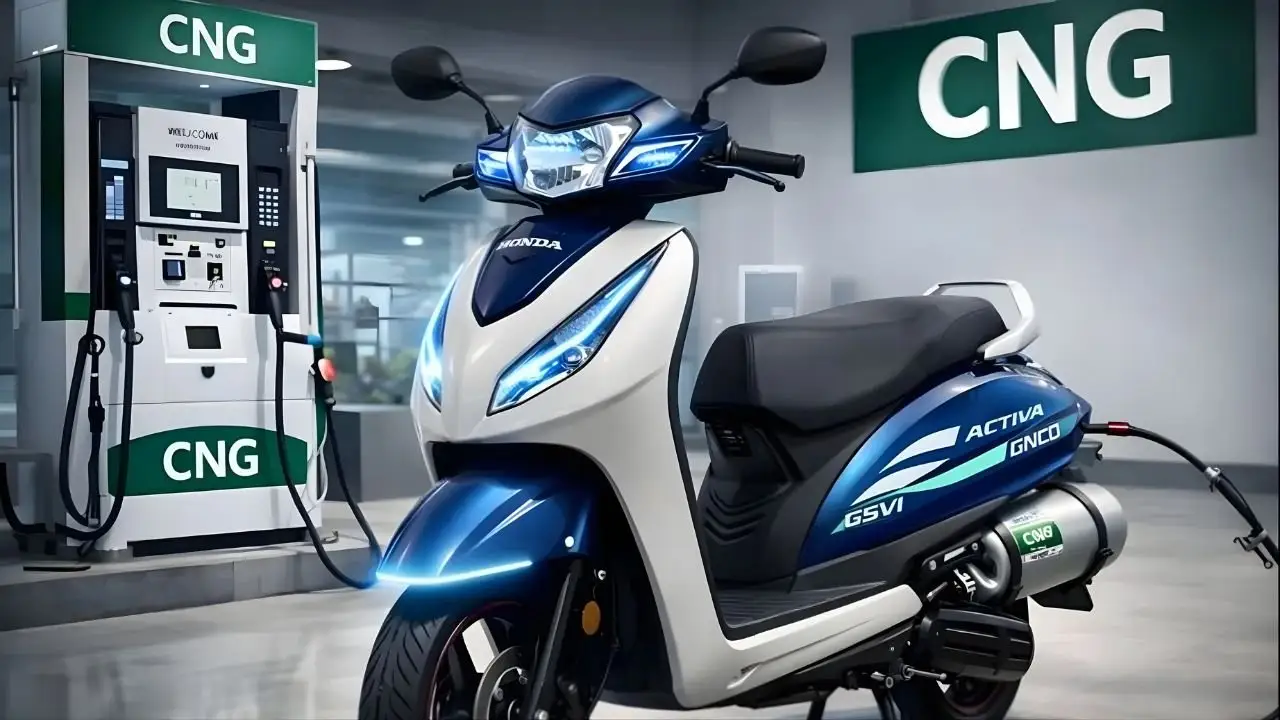
Three hundred and forty kilometres on a single fill. For a scooter priced under ₹50,000, that number is not just impressive — it is the kind of specification that makes buyers stop, reconsider their assumptions about what affordable two-wheelers can deliver, and start doing the monthly fuel cost calculation in their heads immediately. Honda has just unveiled the Activa CNG 2026, and in doing so has brought one of India’s most trusted scooter nameplates into a conversation about sustainable, low-cost urban mobility that the market has been building toward for years.
The Activa needs no introduction to the Indian riding public. It is, by any measure, the country’s most successful scooter — a vehicle so deeply embedded in daily commuting across urban, semi-urban, and rural India that its name functions as a near-generic term for gearless two-wheelers in many regional conversations. When Honda attaches the Activa name to a dual-power CNG technology platform and prices the result at ₹49,900, the announcement carries market weight that extends well beyond the specifications on the launch sheet.
The Dual-Power System: What It Actually Does
Petrol and Electric Assistance Working Together
The Honda Activa CNG 2026 introduces a dual-power architecture that pairs a conventional CNG-compatible petrol engine with an electric assistance system — a combination that addresses the specific performance profile of Indian urban commuting more intelligently than either technology would manage independently.
The electric assistance component activates in the conditions where it contributes most: low-speed urban traffic, stop-and-go congestion, and intersection starts where a pure CNG engine’s throttle response can feel sluggish. The electric input smooths out exactly the hesitancy that has historically made CNG two-wheelers less appealing than their running cost advantages would otherwise suggest. It essentially makes the CNG powertrain feel like a petrol engine in terms of responsiveness, while delivering the fuel economy of CNG.
The result is a scooter that does not ask its rider to accept a degraded riding experience in exchange for lower fuel costs — which has been the quiet objection that has kept CNG adoption in two-wheelers limited despite the economics making obvious sense.
340km: The Range That Changes the Conversation
The 340 km claimed range from the dual-power system is the headline specification that will drive consideration, and it deserves honest assessment alongside its impressive headline value. This figure represents the extended range made possible by CNG’s higher energy density relative to petrol at equivalent volume — CNG vehicles routinely achieve range figures that would require implausibly large petrol tanks to replicate through petrol efficiency alone.
Real-world range will depend on CNG tank capacity, riding conditions, the proportion of electric assistance deployment, and rider weight. A realistic expectation under typical mixed urban and semi-urban Indian conditions might settle between 250–290 km — still an exceptional figure for a scooter in this price bracket and one that dramatically reduces the frequency of refuelling stops that erode time and convenience in daily commuting.
The more relevant daily calculation for most buyers is not the maximum single-fill range, but the week-to-week fuel expenditure. On that measure, CNG’s price advantage over petrol — typically 40–60% lower per kilometre in Indian urban markets — makes the Activa CNG 2026 one of the most economical motorised transport options available at any price point.
Design: The Activa Formula, Trusted and Continued
Honda has made the correct decision in keeping the Activa CNG 2026’s design firmly within the visual family that generations of Indian riders have associated with reliability and practicality. This is not a product that needs radical styling to announce a technology shift — it needs familiar, approachable design to signal that the CNG transition does not require the rider to compromise on the Activa ownership experience they already understand.
Refreshed graphics, updated lighting elements, and polished panel surfaces give the CNG variant a contemporary feel without departing from the practical, unintimidating proportions that make the Activa universally accessible. The scooter looks current without looking unfamiliar — exactly the design brief that a mass-market technology introduction demands.
For a buyer considering CNG for the first time, the Activa’s familiar form language reduces the psychological barrier to adoption. This is a Honda, it looks like an Activa, and everything about it signals that the technology inside is an enhancement rather than an experiment.
Riding Experience and Comfort
The chassis and suspension setup on the Activa CNG 2026 carries forward the Activa’s established strengths in this area. A well-cushioned, generously proportioned seat accommodates rider and pillion across the range of journey types — quick urban errands, longer commutes, and the occasional family outing — without the hard edge that economy-focused scooters sometimes present.
The footboard space, storage capacity, and relaxed upright riding position reflect Honda’s deep understanding of how Indian riders actually use a scooter daily rather than how they use one in controlled test conditions. Handlebar geometry keeps the riding posture natural and unstrained across extended urban sessions, and the chassis balance at low speeds — the speed regime where CNG scooters spend the majority of their operational time — is composed and confidence-inspiring.
The suspension manages Indian road surface irregularities with the composed absorption that Activa riders have historically relied upon, maintaining ride quality without sacrificing the responsive handling that urban maneuvering demands.
Safety and Build Quality: Honda’s Non-Negotiables
Honda’s approach to safety on the Activa CNG 2026 reflects the same priorities that have made the standard Activa a vehicle trusted by conservative buyers, families, and first-time two-wheeler users across India. The braking system delivers consistent, predictable stopping power — particularly important in the dense stop-and-go urban traffic where the Activa CNG will spend most of its operational life.
The structural integrity of the frame provides stable, balanced handling through the variety of urban riding situations — sudden direction changes, tight navigation through congested spaces, and occasional uneven surface crossings — that characterize real-world Indian scooter use. Honda’s manufacturing quality standards, reinforced by decades of Indian market production experience, deliver the build consistency that supports the Activa’s strong long-term reliability reputation.
CNG-specific engineering considerations — tank mounting, fuel line integrity, valve safety — have been addressed to Honda’s characteristic thoroughness, which matters considerably for buyer confidence in a technology that involves compressed gas storage on a two-wheeler.
Pricing and Ownership Economics
₹49,900: A Number That Resets Expectations
The ₹49,900 starting price for the Honda Activa CNG 2026 is a strategic pricing decision as much as it is a production cost outcome. By landing under the ₹50,000 threshold with a product that delivers 340 km claimed range and Honda’s quality assurance, the CNG Activa enters a price bracket where the standard petrol Activa competes — effectively offering the CNG version as a cost-neutral or cost-advantageous alternative rather than a premium technology add-on.
The running cost differential between CNG and petrol at current Indian market pricing represents the ownership argument that will drive sustained sales beyond launch interest. A commuter covering 1,500 km monthly — common for daily urban riders — saves between ₹1,500–2,500 per month on fuel costs alone by choosing CNG over petrol at equivalent efficiency. Over a three-year ownership period, that saving range accumulates into a total of ₹54,000–90,000 — a figure that more than justifies any initial price consideration.
Honda’s national service network, among the most extensive in the Indian two-wheeler market, provides the after-sales support infrastructure that CNG technology adoption requires. Buyer confidence in a new powertrain technology correlates directly with confidence in the service ecosystem that supports it, and Honda’s network represents a significant competitive advantage over any new entrant attempting to introduce CNG scooter technology without equivalent service coverage.
Market Impact and Competitive Context
A Segment About to Change
The Indian 110cc scooter segment is the country’s single largest two-wheeler category by volume, and the Honda Activa’s dominance within it gives the CNG 2026 variant a launch platform that no competitor product can match. TVS and Bajaj have introduced CNG technology in the motorcycle segment — the TVS Raider CNG and Bajaj CNG variants have demonstrated market appetite — but the Activa’s specific combination of brand trust, volume scale, and scooter form factor opens a different and larger market opportunity.
For the urban daily commuter who has been watching CNG adoption in autorickshaws and city buses deliver obvious cost savings, the Activa CNG 2026 makes the same technology accessible at a personally owned vehicle level for the first time at this price point and quality level. That addressable market is substantial, and Honda appears positioned to capture a defining share of it.
The environmental dimension — reduced tailpipe emissions relative to petrol, lower carbon intensity of CNG as a fuel — aligns the Activa CNG 2026 with regulatory direction in Indian urban mobility policy, potentially qualifying it for incentives and positioning it favourably as emission standards continue to tighten.
The Road Ahead
The Honda Activa CNG 2026 represents one of the most consequential scooter launches in the Indian market in recent memory. It combines a trusted and beloved nameplate with genuinely innovative dual-power technology, delivers a range figure that removes practical objections to CNG adoption, and prices the package at a point that makes the economics undeniable for the daily commuter who calculates fuel costs with precision.
Whether the real-world range and long-term CNG-system reliability meet the expectations established at launch will determine how quickly adoption scales — and Honda’s engineering reputation provides reasonable confidence that the product will perform as promised under sustained daily use.
The Indian scooter market is entering a transition. The Activa CNG 2026 may well mark the moment when that transition moved from tentative to inevitable.