Toyota has a habit of timing hybrid product introductions to land precisely when the market is most ready to receive them. With fuel prices sustaining upward pressure across India and premium SUV buyers increasingly factoring running costs into purchase decisions that once focused exclusively on features and brand prestige, the Toyota Corolla Cross Hybrid 2026 arrives at a moment when its core proposition — genuine hybrid efficiency in a premium, well-featured package — carries more commercial weight than it would have even two years ago.
At an expected price range of ₹35–45 lakh, the Corolla Cross Hybrid enters the premium mid-size SUV segment with a powertrain advantage that most of its direct competitors cannot currently match. Self-charging hybrid technology, a projected efficiency of 20–25 kmpl, Toyota’s well-earned reliability reputation, and a feature set that includes Level 2 ADAS safety systems and a premium connected interior collectively make this one of the more complete new-entry SUV propositions in the Indian market this year. For the family buyer or urban professional who has been watching the premium SUV space waiting for the right product to justify the investment, the Corolla Cross Hybrid 2026 makes that timing decision considerably easier.
Design: Bold Without Being Busy
An Exterior That Commands Attention Cleanly
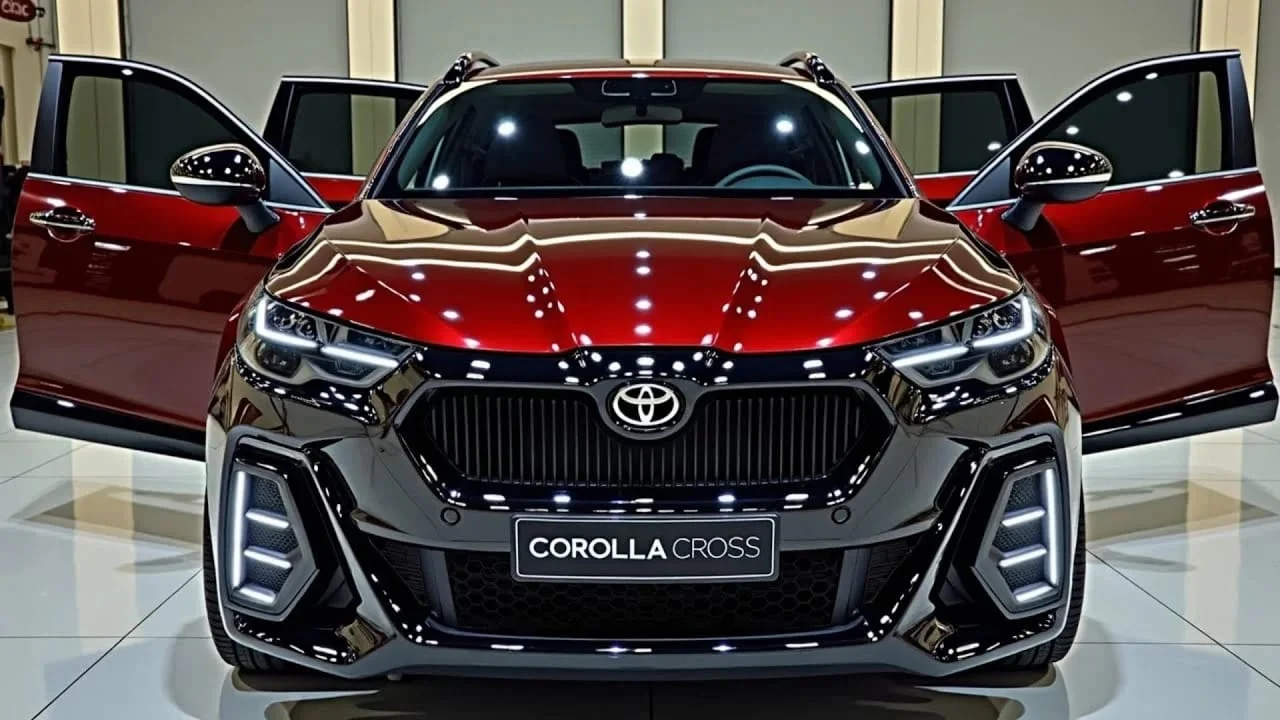
The Toyota Corolla Cross Hybrid 2026 wears its SUV credentials with a design confidence that does not require excessive visual complexity to establish presence. The front fascia leads with a muscular grille treatment flanked by sharp LED headlamps — a combination that creates an assertive face without the overstated aggression that can make some premium SUV fronts look overwrought after the initial impression fades.
The body structure prioritises aerodynamic efficiency without surrendering the raised SUV stance that buyers in this segment expect. Ground clearance is calibrated for the range of surfaces that Indian road conditions present — urban tarmac, potholed semi-urban approaches, and the occasional monsoon-disrupted highway stretch — without reaching the SUV-imitation territory where ground clearance is claimed but never needed. Stylish alloy wheel designs complete an exterior package that reads as premium across the price bracket without calling attention to specific design choices over the vehicle’s overall visual coherence.
This is not a design that will divide opinion sharply — it will not generate the strong reactions of the most polarising premium SUV designs in the segment. What it delivers instead is the kind of resolved, complete appearance that ages gracefully and that buyers feel comfortable with across a five-to-seven-year ownership period rather than feeling trend-dependent within eighteen months of purchase.
Hybrid Powertrain: The Core Advantage
How the Self-Charging System Actually Works
The Toyota Corolla Cross Hybrid 2026’s powertrain pairs a petrol engine with an integrated electric motor in Toyota’s established self-charging hybrid architecture — a system that the brand has refined across millions of units globally over more than two decades and that carries a real-world reliability track record that no competitor’s first or second-generation hybrid system can currently match in terms of demonstrated longevity.
The system’s fundamental operational advantage for the Indian market is its independence from external charging infrastructure. The hybrid battery charges through regenerative braking and petrol engine surplus energy recovery during normal driving — requiring no behavioural adaptation from the driver and no dependence on charging station availability that continues to constrain pure EV and plug-in hybrid adoption outside major metro areas. Drive the car normally, and the hybrid system manages energy optimisation automatically and invisibly.
The electric motor’s contribution is most pronounced in the driving scenarios where Indian urban commuters spend the most time: low-speed city traffic, stop-and-go congestion, and the frequent short acceleration and deceleration cycles of dense urban environments. In these conditions, the electric motor handles propulsion with instant torque delivery and zero fuel consumption — the petrol engine stepping in smoothly as speed and load demand increase. This operational profile produces the efficiency benefits where they matter most for daily urban use, rather than optimising for conditions that test cycles measure but real commuters rarely encounter.
20–25 kmpl in a Premium SUV: What It Means for Running Costs
The projected efficiency range of 20–25 kmpl for the Corolla Cross Hybrid 2026 requires contextualisation against what premium SUV buyers in its price bracket currently accept. Conventional petrol-powered competitors in the ₹35–45 lakh range typically deliver real-world mixed-use efficiency of 10–14 kmpl. A premium SUV covering 20,000 km annually at 12 kmpl requires roughly 1,667 litres of petrol — at current prices, a significant annual operating cost.
The Corolla Cross Hybrid at a conservative real-world 18–20 kmpl under comparable conditions reduces that consumption by 30–40% — a saving that, over a five-year ownership period, accumulates into a total that meaningfully changes the total cost of ownership comparison against non-hybrid alternatives, even accounting for the Corolla Cross’s premium acquisition price within the segment.
For the premium SUV buyer who previously accepted high running costs as the unavoidable price of vehicle size and brand positioning, the Corolla Cross Hybrid’s efficiency argument reframes the purchase economics in a way that competitors without hybrid systems cannot counter directly.
Interior: Premium Quality, Practical Layout
A Five-Seat Cabin Built Around the Journey
The Corolla Cross Hybrid 2026’s interior prioritises the quality of the experience across a full journey rather than maximising specification density. High-quality surface materials throughout the cabin create a tactile premium environment that buyers at this price point can distinguish from less carefully specified interiors within moments of entry — a distinction that matters in a segment where premium presentation is a purchase expectation rather than a bonus.
Five-seat accommodation provides generous space across both rows for the family use case that this SUV targets. Legroom and headroom in the rear sit comfortably within the range that adult passengers occupy for extended journey durations, and seat cushioning and back support reflect the priority Toyota has placed on comfort across the longer highway journeys that a premium family SUV regularly undertakes. The cabin’s acoustic insulation suppresses external noise effectively — a quality characteristic that both the hybrid system’s occasional electric-only operation enhances and that the base vehicle engineering must support to sustain across all driving modes.
Technology That Serves Daily Use
The large touchscreen infotainment system delivers navigation, entertainment, and smartphone connectivity through an interface designed for clear, accessible operation rather than intimidating depth. Wireless device charging removes the cable clutter from the front cabin environment — a small but daily quality-of-life improvement that buyers notice on every journey.
The digital instrument cluster presents speed, hybrid system status, efficiency data, and driver assistance information in a clear, glanceable format that keeps the driver informed without requiring extended attention away from the road. Wireless Apple CarPlay and Android Auto connectivity is expected across the range, reflecting where buyer expectations in this price bracket have settled firmly.
Safety: Toyota Safety Sense at the Premium SUV Standard
The Corolla Cross Hybrid 2026’s active safety suite reflects Toyota’s global commitment to making advanced driver assistance available across its product range rather than reserving it for flagship pricing. The 360-degree camera system provides complete perimeter awareness for parking and low-speed maneuvering in the tight urban spaces that a vehicle of this size navigates daily.
Adaptive cruise control manages highway following distance automatically, reducing the sustained concentration demand of long-distance travel on Indian national highways. Lane-keeping assistance monitors lane position and applies corrective steering input before unintended departure becomes a safety event. Automatic emergency braking responds to obstacle detection faster than human reaction times allow — a capability whose most important contribution is not the dramatic pre-collision stop that demonstrations showcase, but the countless micro-interventions that reduce severity in situations where drivers respond correctly but fractionally too slowly.
These systems collectively represent the Level 2 ADAS standard that premium segment buyers in India increasingly expect and that the Corolla Cross delivers in a format that has been validated across Toyota’s global production volumes — a reliability confidence that brand-new ADAS implementations from less experienced manufacturers cannot match.
Competitive Positioning: Where the Corolla Cross Wins Arguments
Against the Premium SUV Alternatives
The ₹35–45 lakh premium mid-size SUV space in India is occupied by strong products from Hyundai, Kia, and MG at the lower end of that range, with the Jeep Meridian and upper specifications of the Tata Harrier and Mahindra XUV700 competing at its mid-point. The Corolla Cross Hybrid’s differentiation from all of these is primarily the powertrain — no direct competitor at this price point currently offers Toyota’s self-charging hybrid technology with its demonstrated real-world reliability record.
Against the Hyundai Tucson Hybrid, which is the closest specification competitor, the Corolla Cross argues on Toyota’s stronger dealer and service network in India, potentially competitive pricing within the hybrid premium bracket, and the brand’s long-established hybrid reliability reputation. Against non-hybrid alternatives, the running cost differential builds the argument over time — strongest for buyers who cover high annual mileages and retain vehicles for five years or more.
Toyota’s after-sales network and spare parts accessibility across India’s geographic range — including the tier-2 and tier-3 city markets where premium SUV adoption is growing strongly — provides a long-term ownership support foundation that imported or less-established brand alternatives cannot readily replicate.
The Investment Case for the ₹35–45 Lakh Buyer
The decision to spend ₹35–45 lakh on a premium SUV involves a complex set of purchase criteria that specification comparisons capture only partially. Brand confidence, expected reliability across a five-to-seven year ownership horizon, running cost predictability, and resale value trajectory all factor into the total ownership calculation alongside the launch-day feature list.
On each of these dimensions, the Toyota Corolla Cross Hybrid 2026 presents a credible case. Toyota’s brand trust in India is among the highest in the passenger car market. The hybrid system’s global track record provides reliability confidence that new entrants cannot establish without time. Hybrid technology has demonstrated strong resale value retention in markets where it has been established longer than India — a forward indicator of what the Corolla Cross’s resale trajectory may look like as hybrid familiarity and acceptance grows in the Indian secondary market.
What Comes Next
The Toyota Corolla Cross Hybrid 2026 enters a premium SUV market at a moment of genuine transition — where hybrid powertrains are moving from novelty to expectation among informed premium buyers, where running cost consciousness has reached the ₹35–45 lakh segment with meaningful commercial impact, and where Toyota’s investment in making its hybrid technology reliable and accessible is beginning to convert into market share that competitors without equivalent powertrain options struggle to defend.
The coming months of sales data will confirm whether the Corolla Cross Hybrid’s proposition resonates with Indian premium SUV buyers as strongly as its specification and pricing suggest it should. The ingredients are well assembled. The timing is better than it has ever been. And Toyota’s execution track record across its Indian product launches provides reasonable confidence that the delivery will match the promise.
For the premium SUV buyer who has been waiting for efficiency, reliability, and features to arrive together in a single package at a price that makes long-term ownership sense — the wait is over.