India’s premium SUV segment has been building toward a moment like this. Buyers in the ₹35–45 lakh bracket have long had to choose between the Toyota Fortuner’s legendary road presence and mechanical durability, the Jeep Meridian’s distinctive character, and the Mahindra XUV700’s remarkable value proposition. None of those options arrives with a strong-hybrid powertrain, dual curved displays, and a feature set calibrated for both Mumbai expressways and Rajasthan highway runs. The Kia Sorento 2026 does — and with its India launch now confirmed, the competitive dynamics of this segment are about to get considerably more interesting.
Kia has earned the right to be taken seriously in India. The Seltos and Carens established the brand’s ability to read the Indian market accurately, and the Sonet proved that premium design and feature content could find buyers well below the ₹20 lakh mark. The Sorento represents Kia’s most ambitious statement yet in this market — a seven-seat hybrid SUV that competes on every dimension that matters to the Indian family buyer simultaneously, rather than asking them to accept a trade-off.
Design: Commanding Without Trying Too Hard
Exterior Presence That Earns Its Footprint
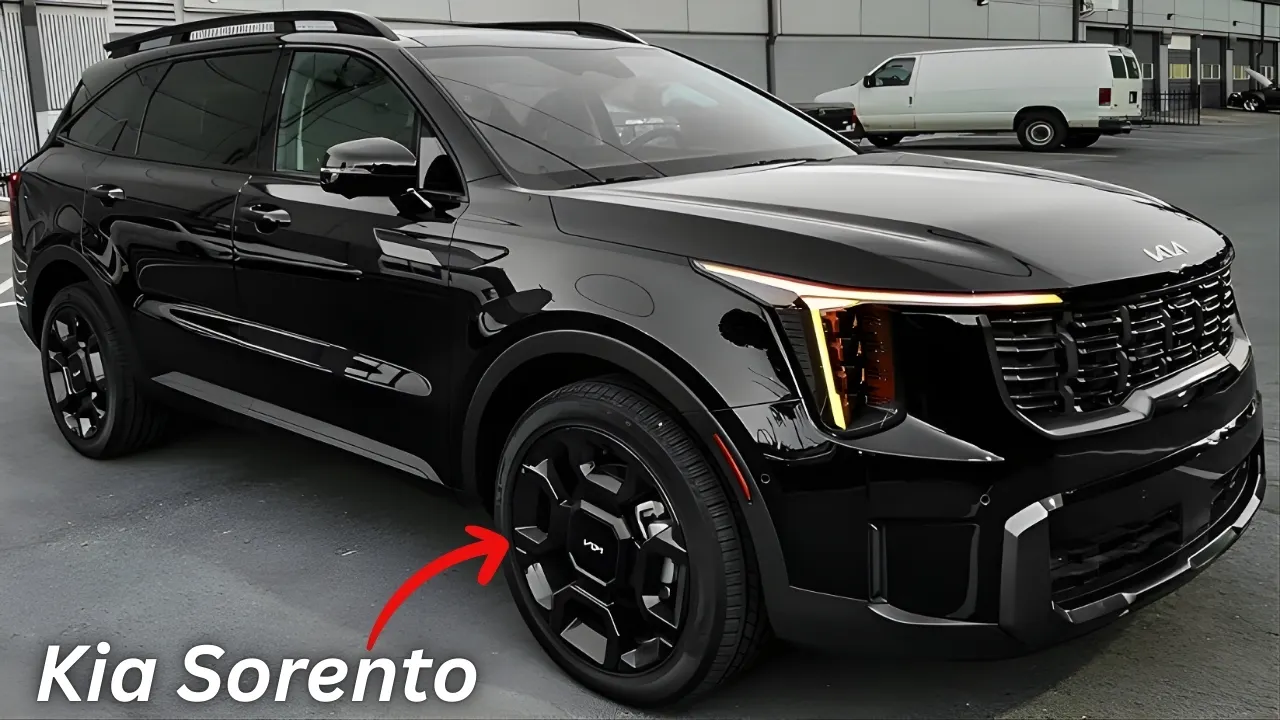
At over 4.8 metres in length with a 2,815mm wheelbase, the Kia Sorento 2026 occupies serious road real estate — and it wears those dimensions with confidence. The front fascia centres on Kia’s signature rectangular grille, flanked by vertically stacked LED headlamps that create an instantly recognizable face distinct from anything else in the segment. The overall stance is wide, planted, and purposeful rather than merely large.
The C-pillar treatment, roof rails, and 19-inch alloy wheel design give the Sorento’s profile a coherent visual logic — each element reads as considered rather than assembled from a parts catalogue. Spy shots captured during Indian road testing confirmed that the production specification arrives essentially unchanged from the international version, which speaks well of Kia’s confidence in the design’s market fit.
For urban driving, the dimensions require a degree of spatial awareness, but the available 360-degree camera system makes parking and tight-space maneuvering considerably less demanding than the footprint would suggest.
Interior: Where the Sorento Makes Its Strongest Case
A Cabin That Redefines the Segment’s Benchmark
Step inside the Sorento 2026 and the quality of the interior experience becomes the dominant impression immediately. The dashboard architecture centres on dual 12.3-inch curved displays — one for the instrument cluster, one for infotainment and navigation — integrated into a single seamless panel that brings a visual sophistication to the interior that most competitors in this price bracket have not yet matched.
Front seat occupants benefit from ventilated, power-adjustable chairs with memory function — a feature combination that matters significantly in India’s climate, where seat ventilation transitions from a luxury to a practical comfort necessity across most of the country for most of the year.
Rear passengers have not been treated as an afterthought. Dedicated air conditioning vents, USB charging ports, and wireless charging access in the second row reflect genuine attention to how Indian families actually use a seven-seat SUV in daily life — typically with the second row occupied as often as the front. A panoramic sunroof and ambient lighting complete an interior atmosphere that justifies the premium positioning without feeling ostentatious.
The third row folds flat when not in use, delivering cargo flexibility that transforms the Sorento from family hauler to practical load carrier with minimal effort. The 12-speaker Bose audio system rounds out a feature list that, taken as a whole, represents the most comprehensively specified cabin in the segment at the expected price point.
Powertrain: Hybrid Where It Matters Most
1.6-Litre Turbo-Hybrid Doing the Work of Something Much Larger
The expected powertrain for the Indian market Kia Sorento 2026 — a 1.6-litre turbocharged petrol strong-hybrid system producing approximately 238hp — deserves attention beyond the headline horsepower figure. This is a sophisticated hybrid architecture, not a mild-hybrid system that delivers marginal efficiency gains. The electric motor contributes meaningfully to both acceleration and urban efficiency, allowing the 238hp combined output to feel more accessible and responsive than a conventional petrol engine of equivalent displacement would typically manage.
Fuel efficiency estimates in the 18 kmpl range on highways represent a genuinely significant achievement for a seven-seat SUV of this size and weight. In urban driving conditions where the hybrid system’s electric component contributes most actively, real-world efficiency should prove competitive against the diesel-powered rivals that currently lead the segment on running cost arguments.
The 6-speed automatic transmission manages power delivery smoothly, and the potential AWD option addresses the all-weather and light off-road capability that premium SUV buyers in India increasingly expect as a specification checkbox.
Suspension and Ground Clearance: Built for Indian Reality
Kia has specified a McPherson strut front and multi-link rear suspension arrangement for the Indian Sorento — a setup that balances ride compliance over broken surfaces with the composure needed at highway speeds. The approximately 176mm ground clearance clears the majority of Indian road challenges, including the aggressive speed breakers that test suspension geometry across urban India and the occasional monsoon-season water intrusion that catches lower-slung vehicles unprepared.
This is a suspension tune that acknowledges Indian road conditions as the primary engineering constraint rather than treating European ride dynamics as the default target — a distinction that matters considerably in daily ownership.
Safety: Five-Star Credentials, Locally Relevant Features
The Kia Sorento 2026’s safety architecture starts from a strong international baseline. The five-star Euro NCAP rating that the global model carries provides an independently verified structural and passive safety foundation that positions it among the safest vehicles available at this price point in India.
The active safety suite extends to Level 2 ADAS — adaptive cruise control, lane-keeping assistance, blind-spot monitoring, and autonomous emergency braking with pedestrian detection capability. Seven airbags, electronic stability control, hill descent control, and tire pressure monitoring complete a safety specification that addresses both the regulatory landscape and the genuine risk environment of Indian road use.
Multi-collision braking — which applies the brakes automatically following an initial impact to reduce secondary collision damage — is a feature that remains uncommon at this segment’s pricing and adds meaningful real-world protection for family occupants.
Pricing and Competitive Positioning
Where ₹35 Lakh Gets You in 2026
Expected pricing of approximately ₹35 lakh for entry variants, with top specifications approaching ₹40 lakh, places the Kia Sorento 2026 in direct confrontation with the Toyota Fortuner’s starting point of around ₹33 lakh — and the competitive argument is more complex and interesting than a simple price comparison suggests.
The Fortuner’s strengths are well-documented: body-on-frame durability, Toyota’s after-sales reputation, and the social currency that the nameplate has accumulated over two decades in India. These are real advantages that buyers weigh seriously. But the Fortuner cannot match the Sorento’s hybrid efficiency, interior technology, or passenger comfort in the second and third rows — and increasingly, Indian premium SUV buyers are making decisions that weight comfort and technology more heavily than they did five years ago.
The Jeep Meridian offers a distinctive brand experience but lags on feature content at equivalent price points. The Mahindra XUV700 delivers remarkable value but sits in a lower perceived-premium tier. The Sorento’s positioning — genuinely premium interior, hybrid powertrain efficiency, strong safety credentials, and seven-seat flexibility — addresses a specific combination of buyer requirements that the current segment leaders do not simultaneously satisfy.
If Kia pursues local manufacturing for the Sorento, pricing pressure on that ₹35 lakh entry point could make the value case even more compelling and extend the model’s reach deeper into the consideration sets of buyers who might otherwise default to the Fortuner on price familiarity alone.
Launch Timeline: What Buyers Should Know
The Kia Sorento 2026 is on course for a second-half 2026 arrival in Indian showrooms, with mid-year the most credible scenario based on the frequency and coverage of test mule sightings on Indian roads. The appearance of test vehicles on public roads across multiple Indian states over recent months indicates that Kia’s local validation programme is progressing on schedule rather than encountering unexpected delays.
Kia India has maintained deliberate silence on specifics ahead of a formal reveal, which is standard pre-launch protocol. Bookings are expected to open in proximity to the official launch announcement — buyers with serious purchase intent should register their interest through Kia’s official channels to receive early notification.
The Verdict Before the Verdict
The Kia Sorento 2026 arrives in India with the strongest combination of hybrid efficiency, interior quality, and safety technology the premium seven-seat SUV segment has seen at this price point. It does not ask buyers to compromise between wanting a comfortable family vehicle and wanting something technologically current — it offers both, together, at a price that challenges the segment’s established order directly.
The months between now and the showroom launch will sharpen expectations on both sides of the transaction. But if the production reality matches the specification promise — and Kia’s recent Indian launches suggest it will — the Sorento 2026 has the ingredients not just to compete in India’s premium SUV segment, but to genuinely redefine what buyers expect from it.