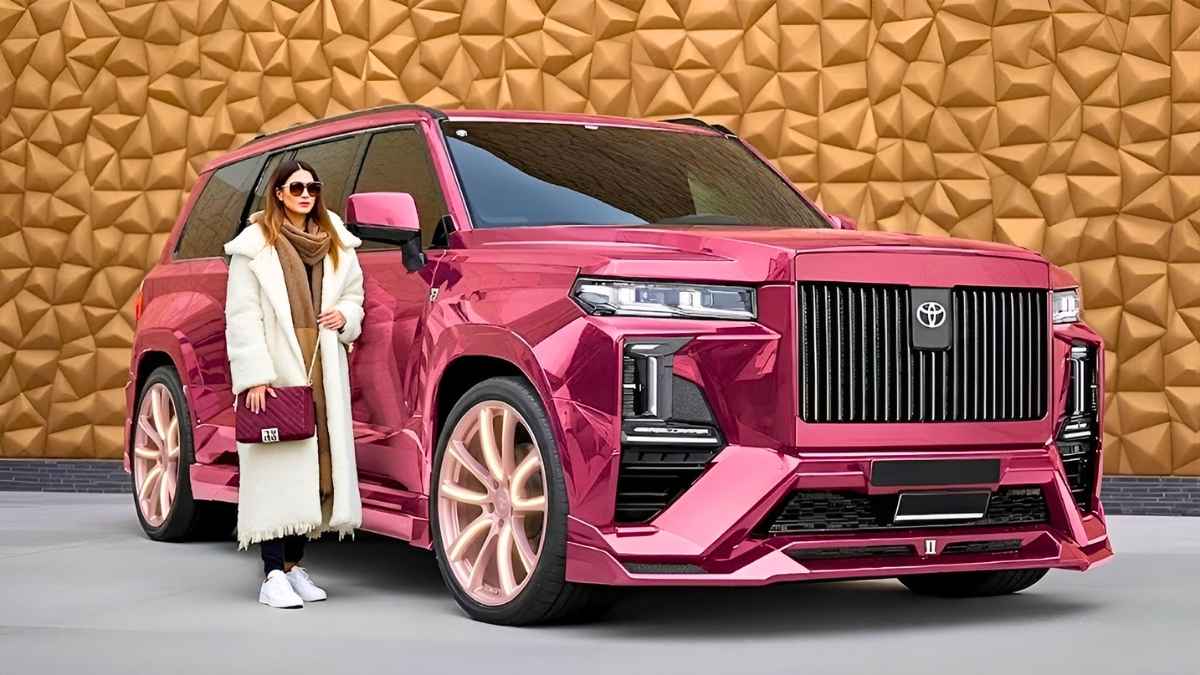
In a world where luxury cars increasingly compete on horsepower figures, aggressive styling, and technology spectacle, the Toyota Century has always operated by a completely different set of rules. It does not shout. It does not perform. It simply arrives — quietly, unhurriedly, and with an absolute conviction that true luxury has never required an audience. The new 2026 Toyota Century redefines what a flagship vehicle can mean in the modern era, and it does so by doubling down on the philosophy that made the nameplate legendary in the first place: the passenger’s experience above all else, delivered with Japanese craftsmanship that no amount of badge prestige can substitute for.
What makes this moment significant is the context in which the 2026 Century arrives. Ultra-luxury automotive has become increasingly performative — Rolls-Royce builds SUVs, Bentley chases lap times, and even traditional chauffeur-driven flagships have acquired the language of performance to remain relevant to younger wealthy buyers. Toyota has watched all of this and made a deliberate choice not to follow. The 2026 Century instead represents a confident statement that a significant and sophisticated segment of the global luxury market is not looking for drama — it is looking for the finest possible execution of calm, comfort, and refinement. That buyer exists, and Toyota has built their car.
Design: Authority Through Restraint
An Exterior That Communicates Without Competing
The 2026 Toyota Century’s design philosophy can be summarised in a single word: composure. Where competitors at this price level load their exteriors with character lines, aggressive grille treatments, and visual complexity, the Century achieves its presence through proportion, surface quality, and an absence of superfluous detail that requires genuine design confidence to execute.
The front grille reads as bold without being aggressive — wide enough to establish authority, restrained enough to maintain dignity. LED headlamp units integrate cleanly into the front fascia without the theatrical flourishes that characterise many contemporary luxury vehicles. The body’s long, balanced proportions communicate the wheelbase and interior space that chauffeur-driven travel requires without the visual bloat that large dimensions can sometimes produce.
This is a design that ages gracefully rather than expensively. The Century’s previous generations maintained relevance for years without requiring dramatic updates because the design language was never anchored to a specific fashion moment. The 2026 model continues that tradition, and for the buyer profile it serves — executives, dignitaries, individuals whose professional image benefits from measured confidence rather than conspicuous display — it is precisely the correct visual statement.
The Rear Cabin: The Entire Point
Designed for the Person Being Driven
Every serious evaluation of the Toyota Century must begin at the rear, because the rear cabin is where the vehicle’s entire design philosophy concentrates its most serious engineering effort. This is a car built for the passenger in the back seat — the driver is important, but they are not the primary consideration in the way that a sports car or even a conventional luxury sedan prioritises the driver’s experience.
The rear seating environment achieves the kind of physical and sensory comfort that first-class air travel aspires to but rarely delivers consistently. Seat recline extends to a position that allows genuine rest on long journeys. Massage functions address the muscular tension that extended travel in any vehicle accumulates. Climate control maintains the precise temperature environment that each occupant prefers without requiring adjustment or compromise.
Sound management in the Century’s cabin operates at a level that goes beyond merely good — it creates a genuinely different acoustic reality from the world outside. Road noise, wind noise, and mechanical sounds are suppressed to a degree that makes normal conversation feel effortless and private telephone calls feel secure. For a business executive who spends two or three hours daily in transit and treats that time as productive working time, the Century’s cabin provides an environment where concentration is possible in a way that no amount of noise cancellation headphones can replicate in a less well-isolated vehicle.
The quality of materials throughout the interior — carefully selected and hand-finished where it matters — creates a tactile environment that communicates craftsmanship at the level of contact with every surface. This is not luxury as specification — it is luxury as experience, and the distinction is one that buyers at this level understand immediately.
Hybrid Powertrain: Power in Service of Serenity
Smooth, Efficient, and Entirely Appropriate
The 2026 Century’s hybrid powertrain combines a petrol engine with electric assistance in a configuration tuned entirely around the smoothness and seamlessness of power delivery rather than the maximum output figures that other luxury vehicles use as marketing centrepieces. Acceleration builds with the kind of progressive, linear authority that makes the Century feel unstoppable without ever feeling hurried — a character that suits both urban progress through traffic and highway-speed overtaking without requiring the driver to mentally switch modes.
The electric component’s contribution is most apparent at low speeds and during the transitions between stationary and moving that urban driving demands constantly. The absence of the combustion engine’s low-speed reluctance — replaced by the electric motor’s immediate, silent torque — gives the Century’s progress through city streets a quality closer to a well-operated private elevator than a conventional automobile. Movement simply begins, smoothly and quietly, without event.
Fuel efficiency improvement relative to a conventional large-displacement petrol engine represents a meaningful reduction in running costs across the annual distances a chauffeur-driven vehicle covers, and the environmental credentials of hybrid operation align with the corporate sustainability commitments that many of the Century’s institutional buyer organisations now maintain formally.
Technology: Advanced, Accessible, and Never Intrusive
A System That Serves Rather Than Demands Attention
The 2026 Century’s technology integration reflects a design philosophy that consumer electronics manufacturers have largely failed to understand and that Toyota has chosen to apply carefully here: technology should serve the user’s goals invisibly rather than requiring users to adapt their behaviour to the technology’s requirements.
The infotainment system provides navigation, entertainment, and connectivity through a large, clear display whose interface prioritises legibility and immediate comprehension over visual complexity. Rear passengers access the controls they need — entertainment, climate, privacy functions, communication — without requiring instruction or the kind of menu navigation that creates cognitive friction in what should be a frictionless environment.
Connectivity features keep occupants appropriately linked to their professional and personal communications without the vehicle’s systems competing for attention. This is a subtle but important distinction — the Century’s technology supports the occupant’s existing workflow rather than imposing a new one.
The active safety suite — adaptive cruise control, lane-keeping assistance, collision prevention systems — operates with the same philosophical consistency as the rest of the vehicle’s technology: present when needed, unobtrusive when not, and calibrated to support rather than override the driver’s judgment. These systems provide protection and confidence without the constant auditory and visual intervention that less well-calibrated systems apply.
Why the Century Occupies Unique Market Territory
The Philosophy That No Competitor Has Replicated
The luxury vehicle market at the level the Toyota Century inhabits is genuinely small by volume and genuinely diverse in what it offers. Rolls-Royce provides unmatched British heritage and the social visibility that many buyers in this market actively seek. Bentley delivers craftsmanship combined with a performance narrative that positions it as a driver’s luxury vehicle as much as a passenger’s. Mercedes-Maybach offers German engineering precision at a price point that remains somewhat below the Century’s ultimate positioning.
What none of these alternatives provides is the specific combination of Japanese manufacturing consistency, hybrid powertrain efficiency, genuine rear passenger prioritisation, and the philosophical commitment to discretion over display that the Century embodies. These are not abstract qualities — they correspond to specific buyer requirements that a defined segment of the global ultra-luxury market holds as primary evaluation criteria.
The executive who values privacy. The senior official who requires a secure, concentrated working environment in transit. The individual for whom the Rolls-Royce’s conspicuousness is a disadvantage rather than an attraction. These buyers have historically had limited options at the level of execution the Century provides. The 2026 model extends and improves that offering at a moment when the market for its particular philosophy appears to be growing rather than contracting.
Toyota’s engineering reputation — built across decades of demonstrated reliability at scale, across every market and climate condition — provides an ownership confidence foundation that European luxury brands, with their more complex systems and higher maintenance profiles, cannot straightforwardly match. Long-term Century ownership costs, adjusted for the reliability differential, often compare more favourably against alternatives than the acquisition price comparison alone suggests.
The Verdict That Matters
The new 2026 Toyota Century redefines what it means to build a flagship luxury vehicle in the current era — not by adopting the performance vocabulary or technology maximalism that competitors have embraced, but by committing more deeply and more skilfully to the values that have always separated the Century from every other luxury vehicle in the world.
Quiet over loud. Passenger over driver. Craftsmanship over specification. Confidence over performance theatre.
For the buyer who has been waiting for a luxury vehicle that understands these priorities and delivers on them without compromise, the 2026 Century is not merely a compelling option. It is the correct answer — and it has been worth the wait.